
"Oh, I'm not doing that speech..."
Words to strike fear into a PR's heart

I’ve been posting a few stories from my career in the PR and comms sector. No real reason, other than some are quite funny, and I like a good story.
I do think that, together, they might offer a good representation of what working in the sector is like - or at least has been like at times over the past 30-odd years.
One enduring element of the PR profession is the launch event. These can be incredibly stressful to organise and execute but, as is often the case, they can also be some of the most rewarding. Or, at least, the times when you feel like you’re really earning your money.
This one comes from 2006, after I’d moved to France and left my full-time role at the Next Fifteen group in 2003. I continued on and off as a consultant to the group for a few years afterwards.
In my last role as a full-time employee, I’d been running the UK B2B Microsoft account. By 2006, when Microsoft was preparing to launch the latest version of the Office suite of software (you know, Word, PowerPoint, Excel, etc) Inferno was the Next Fifteen agency managing the account. My good friend Grant Currie (here on Substack) was the founder and MD of Inferno, and thought I’d be a safe pair of hands to help manage the launch.
It became a project packed with memorable moments, and not always in a good way.
Some context for those much younger than I am. This was a time before software-as-a-service (SaaS) brought applications accessed in the cloud, with updates take place on a relatively frequent basis. Back in the day, Microsoft would launch a new version of the entire Office suite every few years, and aim to persuade customers that upgrading was a good idea. This wasn’t always easy.
Office had grown into a hugely capable suite of applications with functions much more advanced than simply writing documents, creating presentations, and messing around with spreadsheets. It turns out, however, that most people just used it for writing documents, creating presentations, and messing around with spreadsheets.
Office was a huge cash cow for Microsoft, and convincing business customers to upgrade to Office 2007 was critical if the cow was going to continue producing.
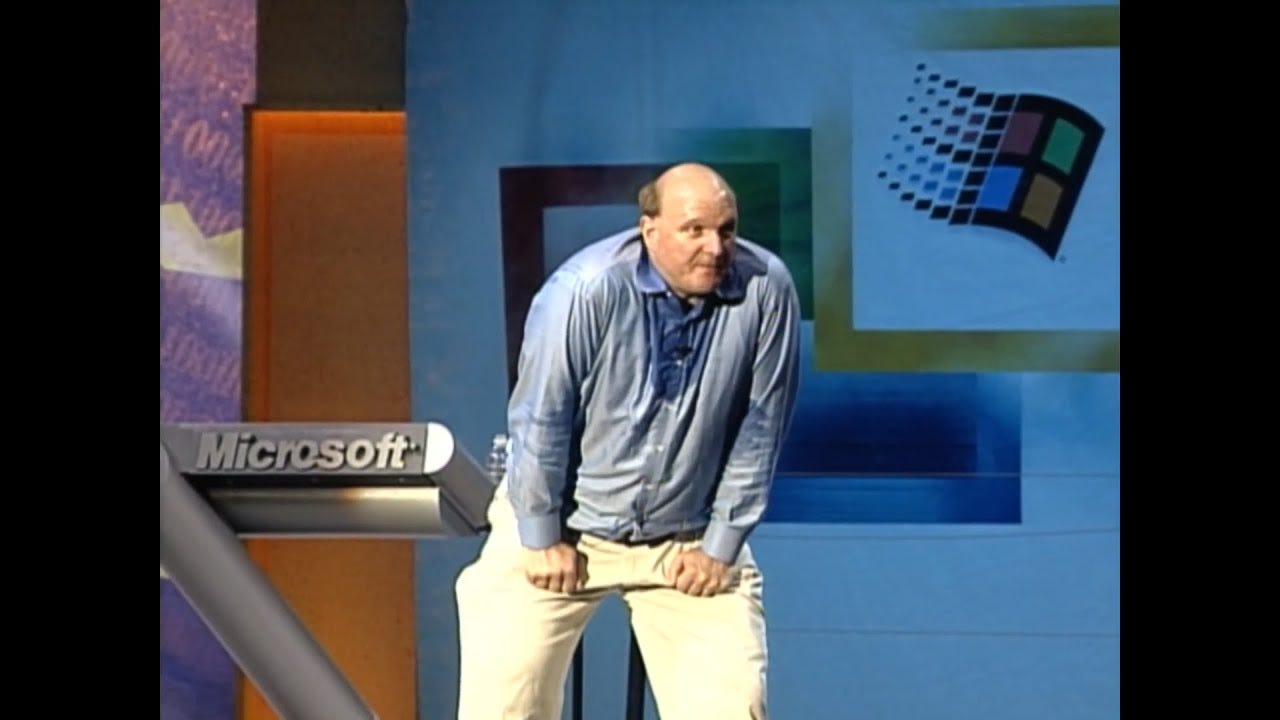
“We gotta milk that cow!” I can imagine Steve Ballmer, Microsoft CEO at the time, sweatily shouting on stage at a company kick-off. “Squeeze those udders! Moo, moo!”
The date for the main business launch event for Office 2007 was set for December 2006. A few weeks before that, however, we were going to reveal the updates to the British trade media in a series of embargoed press briefings.
The team and I had a planning call with the US-based product manager, who explained that the version he’d be demonstrating wouldn’t be the final product.
“It’s pretty much final, just a few tweaks to make,” he told us. “It’s beyond the Beta version. It’s like the Master Beta.”
I’ll pause here. As mentioned, the product manager was American. He had an American accent. “Beta” in UK English is pronounced, “Bee-ta”. With a US accent is pronounced “Bay-ta”.
Take a second to say “Master Beta” with an American accent.
You see the problem?
Of course, as the senior PR guy in the room, it was left up to me to explain why we’d need to find an alternative to “Master Beta” when demonstrating the product to cynical British tech hacks.
The business launch event itself took place in mid-December, at the QEII conference centre in London’s Wesminster. It wasn’t a media event, but rather one to which 300 of Microsoft’s most important UK customers were invited. They’d see the product unveiled, and hear from a number of insightful and entertaining speakers.
Recommending and securing those insightful and entertaining speakers (beyond the execs from Microsoft) was part of my role.
The first of the day, after an introduction from Microsoft’s UK managing director at the time, Gordon Fraser, was the then President of the Confederation of British Industry, John Sutherland.
Sutherland was, I think it’s fair to say, a little old school. His career had largely taken place in a non-digital age, and he wasn’t always seen as the most forward-thinking in terms of technology. But the CBI is the CBI, right? It was a coup to have him opening the conference.
Exactly what he was going to say, however, remained something of a mystery. Which was a worry to both me and the Microsoft team.
Despite almost daily chasing of the CBI team by yours truly, under equally regular chasing of me by the in-house Microsoft team, I didn’t manage to get sight of Sutherland’s speech until the evening before the event.
It’s a slight understatement to say that the speech wasn’t quite as well aligned with Microsoft’s general thrust of the event as they’d have liked. A slighly panicked message arrived:
“Mark, as soon as Sutherland arrives tomorrow morning, you’re going to need to grab him, and steer him towards Gordon so they can have a chat.”
These the words of Sue, the senior Microsoft UK Office marketing manager at the time, and client lead on the launch.
The next morning, I was on high alert for Sutherland. He arrived, I grabbed him.
Me: “John, welcome. I’d just like to introduce you to Gordon Fraser, Microsoft’s UK managing director.”
Gordon: “Hi, John. I wonder if we could have a quick chat about your speech?”
Sutherland: “Which speech is that?”
At this stage my client, Sue, who was standing behind Gordon, looked at me with deep and important questions in her eyes.
Gordon: “You know. The speech your team sent over last night. The one you’re about to deliver.”
Sutherland: “Oh, I’m not doing that speech.”
Gordon, as confused as we were: “Okaaay. So, umm, which speech are you doing?”
Sutherland, slowly tapping his temple with his index finger: “I’m doing one from up here…”
At this point I’m pretty sure Sue mouthed, “what the actual fuck?” to me.
“Why don’t you guys grab a coffee and discuss it?” I suggested.
I left them to it. I had places to be. Jeff Raikes had just arrived.
Raikes was the head honcho of the global Microsoft Office business. Reporting directly into Ballmer, and Bill Gates before him, to Microsoft’s employees Raikes was a god. Even in 2003, his net worth was estimated to be half-a-billion dollars (and apparently about $3bn today). He was in town for the launch, would be speaking on stage, and then spending most of his time glad-handing big customers.
Raikes had a single slot for a media interview. We’d given that to Jack Schofield from The Guardian. Jack sadly passed away in 2020, but was one of the most experienced technology journalists in the UK. He was also a wonderful, gentle man, and seemingly never without his pipe (even if empty). His obituary is worth a read.

I met Raikes and his assistant in reception, and escorted them to the meeting room where the interview would take place. I’d just finished a short briefing when I got a notification than Jack had arrived. I headed off to grab him, telling Raikes and his assistant I’d be back in a minute.
When Jack and I got back, the room was empty.
“That’s odd,” I said. “Perhaps he’s nipped to the bathroom. I’m sure he’ll be back in a min…”
At that moment, the door opened, Raikes’ assistant stepped into the room and in an uneccesarily loud voice said:
“Ladies and gentlemen, Mr Jeff Raikes!”
Raikes entered. Jack, slightly confused but mostly amused, theatrically looked around the room as if to search for the rest of the audience.
I got the coffees.
I’ve got proof, too. Rather brilliantly, the full transcript of the interview is still available on The Guardian’s website:
To set the scene, it's around 8.20am at the QEII Conference Centre in London, where Microsoft is holding a conference for software partners. I'm setting up my tape, and one of the PRs is getting us cups of coffee.
(I’ll forgive Jack for not knowing it was a customer conference rather than a partner one.)
I get another mention towards the end of the transcript:
PR says one last question, we have to go...
Nothing was holding me up that day.
In fact at this point, I could relax for a bit. Which was good, because there was one speaker who I really wanted to hear.
I’d seen the fantastic Sir Ken Robinson’s now famous Ted Talk online from early 2006 (if you haven’t seen it, please do), and I was very keen that Microsoft considered him for the conference.
It took a little convincing. Sir Ken’s focus was on creativity in education, not productivity in business. But I just knew he’d be brilliant and some light relief during the conference. I was delighted that Sue went for it, and he was, indeed, superb.
I was lucky enough to host a couple of planning calls with Sir Ken - he was based in California - and he was an absolute joy to work with. Sir Ken also sadly passed away in 2020, but his legacy lives on through his wonderful writing (and, of course, the videos).
Everything seemed to be going well. John Sutherland hadn’t said anything too outrageous, Sir Ken was brilliant, and after his customer glad-handing I escorted Jeff Raikes to his waiting car.
It was at this point I learned that you can hire Metropolitan Police motorcyclists to give you an escort to Heathrow Airport. Who knew? Time is money, I guess.
Eventually, the day started to come to a close. Just one more activity to go.
In the planning for the event, we’d discussed how we could ensure that delegates stayed around for the whole day. Experienced told us that, after seeing the morning sessions and enjoying some lunch, attendees might start drifting off. Some no doubt anxious to return to work, others perhaps planning on a bit of shopping or heading to the pub. The client was understandably keen that this didn’t happen.
We’d raised the idea that giving some sort of gift at the attendees at the end of the conference might be an incentive to stick around, if (and it was a big if) it was attractive enough.
“Leave it with us,” the Microsoft team said, “we’ve got an idea.”
Calls were made, strings were pulled and, before you know it, one of Microsoft’s hardware partners had agreed that they’d provide a business-grade laptop for every attendee, pre-loaded, of course, with the new version of Office.
Just a reminder. There were 300 attendees. 300 laptops.
We were stunned by the largesse. While we agreed that it handing over fifteen hundred quid’s worth of tech to each attendee would, indeed, stop them heading to the boozer, it created another issue.
Each delegate would need to complete and sign a form accepting the gift, and absolving Microsoft and its partner of responsibility for payment of any local taxes.
We reckoned that it’d take a minute for each delegate to complete the form, so even with five people managing things it’d take an hour at the end of the conference for people to queue up and claim their laptop. We’d need to fill that time with something.
We decided to treat it like a drinks reception, handing out wine, beer, and canapés while people waited. We also thought some entertainment would be a good idea. At the end of a long day of business presentations, this needed to be something a bit different.
I landed on the idea of an after-dinner speaker. And, given the audience (mainly male and middle-aged), maybe someone from the world of sport. England had famously won the Rugby World Cup only a few years before…some of those players must be on the speaker circuit, surely?
We decided that a London-based player would be best, to save on travel and negate the need for accomodation (despite the fact we were giving away half a million quid’s worth of technology, we were still conscious of costs).
But Captain Martin Johnson played for Leicester, golden boy Jonny Wilkinson was up in Newcastle, and cup final try scorer Jason Robinson played in Manchester.
Got it! The big man from the back row played for Wasps, a London-based club. Lawrence Dallaglio!
And so, for the last hour of a very long day, Lawrence Dallaglio joined us, delivered a very entertaining speech, and stuck around afterwards to sign any number of autographs and selfies (this despite it being pre-smartphone, so the selfie I had - which sadly I can’t find - was taken on the very poor camera in my BlackBerry).
Big Lawrence was brilliant, and well worth his not insignificant fee. As the room gradually cleared, and we all started relaxing after a job very well done, I suggested to Lawrence that he could probably slope off.
“It’s no problem. I’m waiting for a couple of mates. We’re going out for a few drinks.”
Shortly afterwards his mates arrived - judging by the size of them, they were teammates - and with cheery goodbyes, they all headed off.
We were done.
Client and agency teams had agreed to have a post-event curry in the West End. I remember going, but not much beyond. If you’d told me that I’d had a beer and nodded off in the corner I’d believe you. More likely, I suspect, I might have made some excuses and headed off early. After a day like that I tend to need to decompress, alone.
Overall, the event was seen as a huge success.
There is, however, a postscript.
In the office a couple of days later, a colleague approached my desk clutching a copy of The Sun.
“You were with Lawrence Dallaglio the other day, right?”
“Yep. He spoke at the Microsoft event and then headed out with a couple of mates.”
“He certainly did. Check this out,” and he tossed the paper onto my desk.
LAWRENCE DALLAGLIO AND FRIENDS THROWN OUT OF MAYFAIR NIGHTCLUB AFTER SPLASHING THOUSANDS ON 10-HOUR BENDER
Easy come, easy go.
Ballmer and his fantastic on stage dancing!
Ah yes chap that was one mental event wasn't it?! I will always remember us quaffing champers with Lawrence and the other rugby lads and having a chat (I *think* Guscott was there?). And then seeing the pictures in the Sun the next day and thinking 'oh shit, we kicked that all off didn't we?!'.