
Communications as a system
Stepping back to step forward (with AI)

Following the lightbulb moment of recognising the platform shift that AI represents for PR and communications, my mind has continued to whirr.
As people who know me will attest, I’m a simple man, and like to put things in simple terms.
PR and communications can be regarded as the guardian of reputation as a corporate asset of quantifiable value (and I’ve enjoyed the work that Burson has done in this area). As such, in my simple terms, the communications function aims to mitigate the risks of reputational damage, and maximise opportunities through reputational enhancement.
I’ve found that abstracting (if that’s the word) the communications function is helpful in looking at where AI’s strengths might be applied (and, equally, where to retain human involvement).
This step back helps reduce a focus on “how can AI help me in the tasks I already do?” (a top- or task-down approach) to “how can AI as a platform support the function of communications?” (the bottom-up approach).
I started to consider communications as a system, and therefore assumed, without having specific experience in it, that “systems thinking” might be useful. (And apologies in advance to any systems thinking experts.)
I found this definition (there are many others, but I liked this one):
“Systems thinking is a holistic approach to analysis that focuses on the way different parts of a system interact and how they influence one another within a whole.”
Again, in my simple terms, I started to see the communications function as:
Inputs (internal and external) > Processing (implications of risks and opportunities) > Outputs (defined comms activities) > Outcomes (aggregated result of outputs).
As I like to do, this led me to grab a piece of paper and a Sharpie.
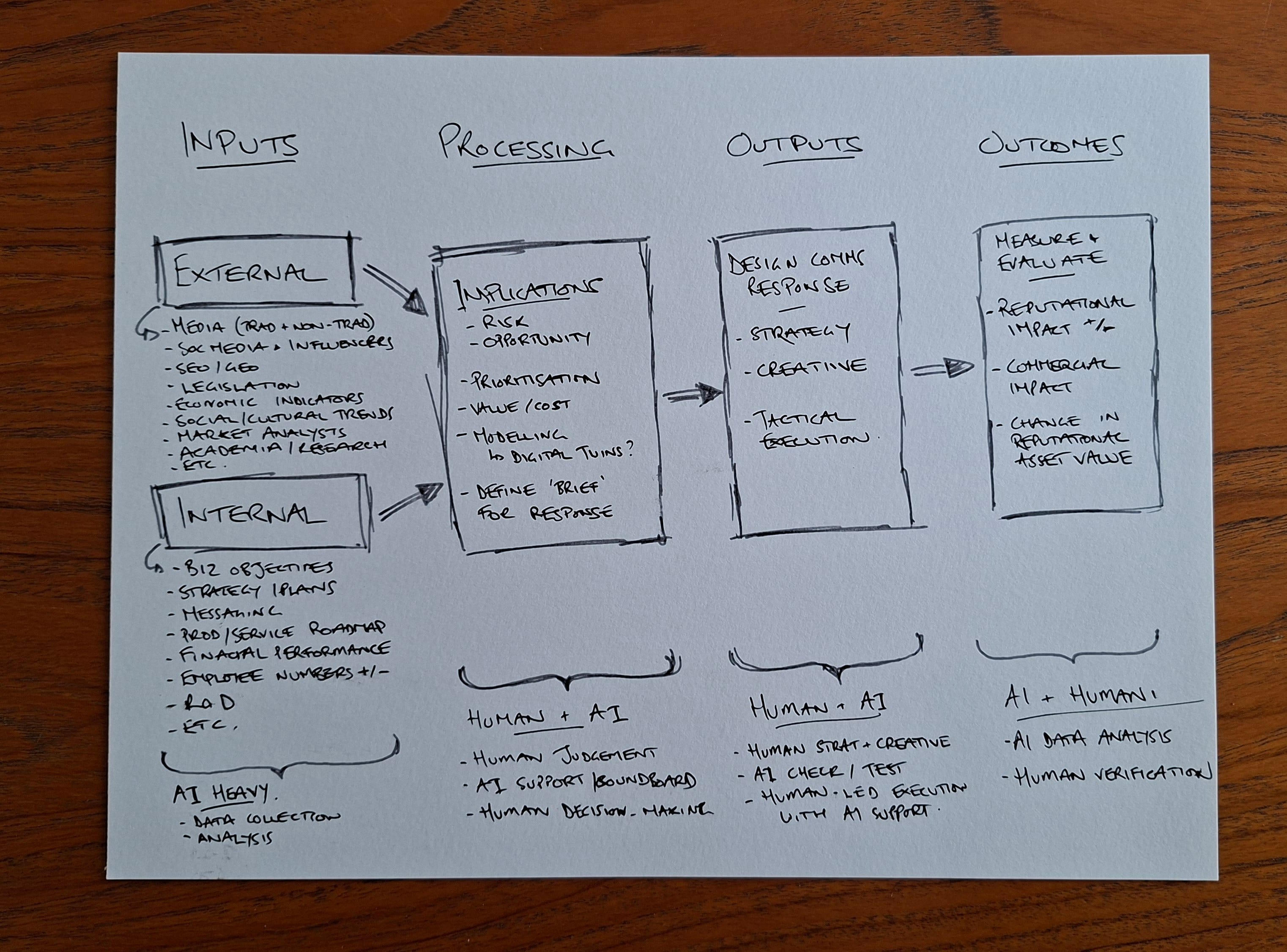
You may not be able to see that very clearly, nor read my handwriting, and I’m not going to claim that my first stab at it is spot on. But it’s definitely helping me clarify where the human/AI interface(s) should be placed within the system, and where the strengths of each can be optimally applied.
What is also immediately apparent to me, as someone who’s been working in the PR and communications sector for more than 30 years, is that AI provides the opportunity to gather data from numerous more sources (externally and internally) that at any time previously.
That’s a good thing, but only if it also allows us to more effectively derive the signal from the noise, which is vital if communications team are going to focus their energies in the most impactful areas.
But (and it’s a big ‘but’) we obviously need to be able to trust the output of AI’s data gathering and analysis of that noise and, therefore the resulting signals (I’ve begun to think of two types of signal: Risk Signals, and Opportunity Signals).
I’ve warmed to the idea of triangulation in this context (though I’m almost certain I’m using it incorrectly!) But, basically, if AI can find data points about the same issue among the noise from three different sources (e.g. traditional media, social media, SEO/GEO), then it becomes a firm signal flagged to the comms team.
I’m also thinking about ways to help spot signals further away than might currently be the case. Identifying sources before they become stories, and spotting the conditions within which signals emerge from the noise. I figure that would have enormous value in supporting communications proactivity vs reactivity.
More to come soon, no doubt.
Have a good weekend.
While this is a great post, and I agree with the content. Can I just point out that you did not use a sharpie for this? Unless they have released a special new sharpie that is very fine...